Section 1: The Persistent Failure Pattern in Modern Organizations
Across industries, ownership structures, and geographies, the cycle repeats with unsettling consistency. A leadership team gathers for a strategic offsite. Markets are analyzed. Competitive threats are mapped. Growth ambitions are declared. Slides are refined. Vision statements are sharpened. The future feels clear, perhaps even inevitable.
Then execution begins. Campaigns launch. Sales pushes intensify. Hiring accelerates. Technology is purchased and implemented. Dashboards multiply. Meetings increase. The organization feels busy, energized, and mobilized.
For a quarter or two, momentum builds. Then something subtle happens. Priorities begin to fragment. Departments interpret strategy through their own incentive structures. Sales optimizes revenue targets. Marketing optimizes lead volume. Operations protects margin. Finance tightens controls. Technology teams pursue roadmap velocity. None of these decisions are irrational. Each is locally defensible. Yet collectively, friction accumulates.
Decision latency increases. Rework expands. Communication density rises. Leadership time shifts from building to resolving. The strategy, once crisp and coherent, begins to blur under the weight of competing interpretations.
At some point, performance plateaus—or worse, destabilizes. The diagnosis is almost always the same:
“We need better execution.”
More accountability. More KPIs. More dashboards. More meetings. More discipline. And so execution pressure intensifies.
What is rarely examined is the structural substrate beneath that execution. The implicit architecture that governs how decisions are made, how information travels, how incentives are aligned, and how authority is exercised. Most organizations treat structure as static and execution as dynamic. In reality, structure is the governing variable.
The persistent failure pattern documented by firms such as McKinsey & Company, in which a majority of strategies fail to achieve intended outcomes, is often attributed to cultural resistance, capability gaps, or inconsistent leadership. Yet these explanations focus on behavior. They underemphasize design.
Similarly, research summarized in Harvard Business Review repeatedly shows that transformation initiatives fail at alarming rates. Organizations mobilize energy but underestimate the architectural redesign needed to sustain it.
The issue is not that leaders lack intelligence. Nor is it that teams lack effort. The issue is that execution is being scaled atop an architecture that was never designed for the ambition it now carries.
As organizations grow, complexity compounds nonlinearly. Product lines multiply. Customer segments diversify. Regulatory exposure increases. Technology stacks expand. Talent specialization deepens. Without deliberate architectural recalibration, the informal systems that once worked at $20 million in revenue fracture at $200 million.
Execution intensity amplifies these fractures. This is the paradox modern leaders confront:
The more urgent execution becomes, the more dangerous it is to accelerate without structural alignment.
Agency theory, articulated decades ago by Michael C. Jensen and William H. Meckling, demonstrated that misaligned incentives create value leakage within firms. Their work was not about marketing or operations; it was about structural misalignment between decision-makers and value owners. The insight remains instructive: when authority, incentives, and information are misaligned, friction becomes embedded in the system itself.
Later governance research by Eugene F. Fama emphasized the separation between decision management and decision control, an architectural distinction necessary for scale. When these layers blur, organizations oscillate between chaos and overcorrection.
What modern business leaders experience as “execution drift” is often architectural ambiguity.
- Who truly owns this decision?
- At what threshold does escalation occur?
- What data governs the choice?
- What tradeoffs are acceptable?
- Who has veto authority?
When these questions lack structural clarity, execution becomes negotiation. Negotiation becomes delay. Delay becomes erosion.
In smaller firms, heroic leadership can temporarily compensate for weak architecture. Founders absorb ambiguity. Senior executives manually resolve conflicts. Informal relationships smooth friction. But heroics do not scale.
As revenue increases, as private equity enters, as boards demand predictability, as AI tools accelerate production capacity, the tolerance for structural ambiguity collapses.
Execution without architecture does not merely stall; it fails. It destabilizes. Architecture-Led Execution™ begins with a different premise:
The problem is not movement. The problem is design. Before scaling effort, leaders must interrogate the structural architecture governing that effort. Before accelerating velocity, they must ensure that authority, information, and accountability are aligned. Otherwise, intensity simply magnifies incoherence.
The organizations that consistently outperform over long horizons are not those that execute the fastest in isolated quarters. They are those that embed structural coherence beneath their execution engine—so that actions compound rather than conflict.
And that is where the discipline of Architecture-Led Execution™ begins.
Section 2: What Is Architecture-Led Execution™?
Architecture-Led Execution™ is not a productivity philosophy. It is not a change-management methodology. It is not an operational excellence program. It is a structural governance doctrine.
Formal Definition
Architecture-Led Execution™ is the disciplined design of organizational structure, decision rights, information flows, and accountability systems before scaling execution—ensuring that enterprise action compounds rather than conflicts.
The order matters. In fact, it is critical. Structure precedes scale. Governance precedes velocity. Clarity precedes intensity. Most firms reverse this order. They scale execution first—through hiring, technology, campaigns, or acquisitions—and only later attempt to retrofit structure when friction becomes intolerable. By then, incentives are entrenched, politics are calcified, and redesign becomes exponentially more difficult.
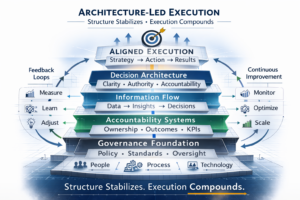
Architecture-Led Execution asserts the opposite sequence:
Define structural boundaries.
Map decision authority.
Clarify information pathways.
Establish accountability ownership.
Then accelerate.
Execution, in this model, is not suppressed. It is stabilized.
Deconstructing the Term Architecture
Architecture is not an organization chart. It is the intentional configuration of:
Role clarity
Decision thresholds
Escalation logic
Data authority
Incentive alignment
Governance cadence
Architecture answers questions that most firms leave implicit:
Who decides pricing changes above 3%?
Who has the authority to sunset underperforming products?
What constitutes sufficient data for capital deployment?
Where does cross-functional veto authority reside?
When these are undefined, politics fills the vacuum. Architecture replaces politics with design.
Execution
Execution is an enterprise movement. It is the translation of strategy into behavior.
However, execution has three states:
Fragmented Execution – departments optimize locally.
Coordinated Execution – leadership manually synchronizes.
Architected Execution – structure inherently aligns behavior.
Only the third state scales predictably.
Understanding Architecture-Led Execution™
To sharpen the boundary:
It is not Strategy Consulting
Strategy defines where to compete and how to win.
Architecture-Led Execution defines how authority and accountability must be structured to enable repeatable winning.
Strategy without architecture becomes aspiration.
It is not Project Management
Project management optimizes discrete initiatives. Architecture-Led Execution governs the system in which all initiatives operate.
It is not Agile Transformation
Agile increases responsiveness at the team level. Architecture-Led Execution determines whether agility reinforces enterprise coherence or fragments it.
It is not Bureaucracy
Bureaucracy introduces controls after failure. Architecture introduces structural clarity before failure. The difference is timing and intent.
The Core Proposition
Execution problems are rarely effort problems. They are architectural problems. When leaders say:
- “We need more accountability,” they are often reacting to blurred authority.
- “We need better communication,” they are reacting to broken information architecture.
- “We need alignment,” they are reacting to structural incoherence.
Architecture-Led Execution reframes these as design challenges rather than behavioral deficiencies.
Economic Deepening
In classical organizational economics, the firm exists to reduce transaction costs relative to market exchange. When internal coordination costs exceed external alternatives, value erodes.
As firms scale, three costs increase nonlinearly:
Decision Latency Cost
Time lost waiting for authority clarification.Redundancy Cost
Duplicated effort across functions.Incentive Misalignment Cost
Actions that optimize departmental KPIs while degrading enterprise value.
Without architectural recalibration, these costs grow faster than revenue. This produces a dangerous illusion:
Revenue increases. Complexity increases faster. Margin compresses. Leadership fatigue intensifies.
Agency theory, articulated by Michael C. Jensen and William H. Meckling, demonstrates that misaligned incentives lead to inefficiency even when all actors behave rationally. Their insight was structural, not moral.
Architecture-Led Execution reduces agency friction by:
Clarifying decision ownership
Aligning incentive structures
Separating decision management from decision control (as emphasized by Eugene F. Fama)
From an economic standpoint:
Enterprise Value = Velocity x Alignment x Accountability
Without architecture:
Alignment coefficient declines as scale increases. Velocity without alignment produces volatility. Accountability without decision clarity produces paralysis. However, architecture is the stabilizing multiplier.
Why Execution Alone Cannot Save You
In nearly every underperforming organization, the prescription arrives with confident simplicity:
We need to execute better.
The phrase carries intuitive appeal. It implies urgency, discipline, and accountability. It signals action over analysis. It reassures boards and investors that leadership recognizes the gap between intention and outcome. Yet it rests on a flawed premise. It assumes execution failure is primarily a deficit of effort, focus, or managerial rigor. It treats underperformance as a behavioral shortfall rather than a structural condition. And in doing so, it directs energy toward acceleration when the underlying system cannot support velocity.
Execution, in isolation, cannot rescue an organization whose architecture is misaligned with its scale, complexity, or ambition. To understand why, we must examine three recurring traps that emerge when leaders attempt to solve structural problems through execution intensity.
1. The Acceleration Trap
When results lag, organizations almost always respond by increasing activity density.
- More campaigns.
- More initiatives.
- More meetings.
- More hires.
- More tools.
- More dashboards.
Execution volume expands under the assumption that output is the limiting factor. In early-stage firms, this often works temporarily. The organization is small enough that informal coordination compensates for structural gaps. Founders bridge silos. Senior leaders arbitrate conflicts in real time. The system flexes through human intervention.
But as complexity grows, coordination costs rise nonlinearly. Each additional initiative introduces new dependencies: marketing relies on product, product relies on technology, technology relies on finance, and finance relies on operations. Without a defined decision architecture and clear authority boundaries, these dependencies create friction.
Acceleration then produces paradoxical outcomes:
Work increases faster than throughput.
Activity rises while outcomes stagnate.
Communication expands while clarity declines.
Leadership involvement deepens while ownership weakens.
The organization feels busy yet ineffective. This is not an execution deficit. It is a structural overload condition. Velocity has exceeded architectural capacity.
2. Local Optimization vs. System Performance
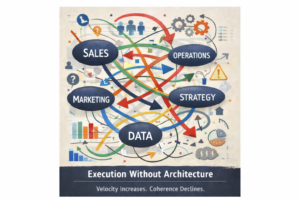
Execution-focused cultures often emphasize departmental KPIs as engines of accountability. Marketing drives lead volume. Sales drives bookings. Product drives releases. Operations drives efficiency. Finance drives cost control. Each function executes against its own success metrics with increasing intensity.
Yet enterprises do not create value through isolated optimization. They create value through coordinated system performance. When architecture is weak, departmental execution diverges from enterprise outcomes in predictable ways:
Marketing maximizes volume at declining quality.
Sales maximizes bookings at declining margin.
Product maximizes features at rising complexity.
Operations maximizes efficiency at declining flexibility.
Finance maximizes control at declining growth capacity.
No actor behaves irrationally. Each optimizes within their incentive structure. But the system drifts.
Systems theorist Peter Senge observed that organizations frequently undermine themselves through well-intended local optimization. The insight is structural: without integrative architecture, subsystems cannibalize each other. Execution alone intensifies this cannibalization. More effort applied to misaligned subsystems accelerates divergence.
Architecture-Led Execution addresses the problem at its source: aligning decision rights, incentives, and information flows so that local execution reinforces enterprise coherence.
3. The Hidden Cost of Misalignment
Execution-first thinking rarely accounts for the economic burden imposed by structural ambiguity. Yet this burden is measurable and material.
Three costs dominate:
Decision Latency
When authority boundaries are unclear, decisions stall in escalation loops. Teams seek consensus rather than act. Meetings proliferate. Senior leaders become bottlenecks.
Latency expands not because teams lack urgency, but because architecture lacks clarity.
Redundant Execution
Without defined ownership, multiple functions pursue overlapping initiatives: parallel analyses, duplicated campaigns, competing vendor engagements, conflicting roadmaps.
Execution increases. Net progress does not.
Leadership Drag
Senior executives become integrators of last resort—resolving conflicts, clarifying priorities, arbitrating tradeoffs. Their time shifts from strategic direction to structural compensation.
Organizations often misinterpret this as leadership dedication. In reality, it is architectural deficiency transferred upward.
Collectively, these costs create a dangerous illusion: the organization appears intensely active while value creation decelerates.
Execution has increased. Coherence has declined.
4. Speed Without Structure Increases Volatility
A final misconception sustains execution-first cultures: the belief that speed itself creates advantage. Speed does create advantage—when direction and coordination are stable. Without architecture, however, speed amplifies variance.
Decisions propagate inconsistently. Initiatives collide. Customer experience fragments. Brand signals diverge. Technology stacks sprawl. Costs escalate unpredictably.
The system behaves less like a machine and more like turbulence.
In such environments, leaders often oscillate between two ineffective responses:
Push harder on execution.
Impose reactive controls.
The first increases volatility. The second introduces bureaucracy. Neither addresses architecture.
Architecture-Led Execution reframes speed as a dependent variable. Velocity is not inherently beneficial. It is beneficial only when structural alignment converts motion into compounding outcomes.
5. Why Leaders Default to Execution Solutions
If structural causes are so pervasive, why do organizations repeatedly prescribe execution remedies? Because execution problems are visible.
Missed targets, slow pipelines, delayed launches, cost overruns—these manifest in metrics. Architecture, by contrast, is largely implicit. Decision rights are unwritten. Incentives are embedded in compensation systems. Authority boundaries exist in informal norms. Information flows through cultural pathways.
Leaders experience the symptoms of architecture daily without naming the architecture itself.
Thus the diagnosis defaults to behavior:
Teams need discipline.
Managers need accountability.
Execution needs rigor.
These statements are not wrong. They are incomplete.
Behavior operates within structure.
Execution operates within architecture.
Until the architecture is designed deliberately, execution intensity cannot stabilize performance.
6. The Structural Threshold
Every organization eventually reaches a scale at which informal coordination collapses. Founders can no longer arbitrate every tradeoff. Leaders cannot personally synchronize every function. Relationships cannot substitute for governance.
This threshold often emerges:
During rapid growth
After acquisitions
Under private equity ownership
During digital or AI transformation
When entering new markets
At this point, execution pressure rises precisely when architecture must be redesigned.
Organizations that recognize this inflection shift from execution escalation to architectural installation. They clarify decision layers. Align incentives. Define information pathways. Establish accountability structures. Governance precedes velocity.
Organizations that miss it continue pushing execution harder against structural limits. One stabilizes while the other fragments.
7. The Core Conclusion
Execution alone cannot save an organization because execution is not the primary determinant of coherence. Architecture is.
Execution supplies energy. Architecture determines direction. Without architecture, energy dissipates. With architecture, energy compounds.
Architecture-Led Execution™ therefore begins not with activity, but with design. It recognizes that sustained performance is not produced by effort intensity, but by structural alignment beneath that effort.
Only when structure stabilizes can execution truly scale.
Architecture as a Precondition for Compounding
Execution produces output. Architecture determines whether that output accumulates or dissipates. This distinction is subtle in the short term and decisive over time. Many organizations can generate bursts of performance through concentrated effort. Few can convert those bursts into sustained, compounding value. The difference is rarely intelligence or ambition. It is structural design.
Compounding requires stability. Stability requires architecture.
1. Structural Leverage: Where Value Actually Multiplies
Compounding is not a motivational concept. It is an economic one.
In finance, compounding occurs when returns are reinvested into a stable system that preserves principal and accelerates growth. In organizations, compounding occurs when execution outputs reinforce structural coherence rather than undermine it.
Architecture provides structural leverage in three primary ways:
A. It Reduces Coordination Friction
Every decision inside a firm carries transaction costs — negotiation, escalation, clarification, revision. As scale increases, these costs grow unless authority boundaries and decision thresholds are clearly defined.
When decision rights are architected deliberately, friction declines:
Fewer escalations.
Faster approvals.
Reduced rework.
Clear accountability.
Time saved at scale compounds.
B. It Aligns Incentives With Enterprise Outcomes
Agency theory, articulated by Michael C. Jensen and William H. Meckling, demonstrated that misaligned incentives create hidden value leakage within firms. Individuals optimize rationally within their own incentive systems, even when doing so degrades overall enterprise value.
Architecture reduces this leakage by structurally aligning:
Incentive systems
Decision authority
Outcome ownership
When incentives reinforce enterprise outcomes rather than departmental metrics, execution reinforces coherence. Alignment compounds. Misalignment fragments.
C. It Preserves Decision Integrity Under Scale
As organizations grow, information asymmetry widens. Leaders cannot personally inspect every decision. Authority must be distributed.
Governance research by Eugene F. Fama emphasizes the structural separation between decision management (who makes decisions) and decision control (who oversees and validates them). This separation is not bureaucratic excess; it is necessary architecture for scale.
When this architecture is absent:
Authority blurs.
Oversight collapses into micromanagement.
Decisions slow.
Risk accumulates invisibly.
When present:
Authority scales predictably.
Oversight stabilizes risk.
Leaders focus on directional allocation rather than operational arbitration.
Decision integrity compounds over time.
2. The Difference Between Growth and Compounding
Many organizations grow. Fewer compound. Growth is linear expansion of output.
Compounding is exponential reinforcement of coherence.
Consider two firms:
Firm A: Execution-Intensive, Architecture-Light
Revenue grows 30% annually.
Headcount doubles.
Tools multiply.
Departments expand independently.
Within two years:
Cross-functional friction increases.
Margins compress.
Leadership bandwidth saturates.
Culture fragments.
Revenue grows. Enterprise coherence declines.
Firm B: Architecture-First, Execution-Scaled
Decision rights mapped before expansion.
Incentives aligned with enterprise KPIs.
Information flow standardized.
Governance cadence installed.
Within two years:
Revenue grows 25%.
Headcount increases strategically.
Leadership bandwidth remains stable.
Margins hold or expand.
Revenue grows. Enterprise coherence strengthens. The difference is architectural integrity. Execution fuels both firms. Architecture determines which compounds.
3. Architecture as a Risk Mitigation System
Compounding requires not only growth, but risk containment. In unstable systems, volatility erodes gains. Architecture stabilizes volatility in three ways:
A. Authority Clarity Reduces Political Risk
When escalation pathways are explicit and decision thresholds defined, political maneuvering declines. Decisions are evaluated against structural standards rather than personal leverage.
B. Information Architecture Reduces Strategic Blind Spots
Without structured information flow, signals fragment across departments. Risk emerges silently — customer churn signals buried in marketing data, margin erosion hidden in product roadmaps, operational inefficiencies masked by top-line growth.
Information architecture creates systemic visibility. Feedback loops expose drift before it compounds negatively.
C. Governance Protects Against AI-Accelerated Instability
In the AI era, execution velocity can increase dramatically. Content production, decision automation, campaign optimization, and data modeling can occur at scale within hours.
Without architecture:
AI amplifies misalignment.
Automated decisions propagate bias.
Brand coherence deteriorates.
Operational risk escalates.
Research from organizations such as Deloitte and Gartner consistently indicates that AI adoption often outpaces governance maturity. Velocity increases before structural oversight stabilizes.
Architecture-Led Execution in the AI era is not optional. It is protective infrastructure. AI multiplies output. Architecture determines whether that output compounds or corrodes.
4. The Compounding Equation
Compounding enterprise value can be framed conceptually:
Enterprise Value ∝ Velocity x Alignment x Accountability x Stability
Execution influences velocity. Architecture influences alignment, accountability, and stability.
Without architecture:
Alignment declines as scale increases.
Accountability diffuses.
Stability erodes.
Velocity becomes volatile.
Over time, the multiplication effect collapses.
With architecture:
Alignment strengthens.
Accountability clarifies.
Stability persists under growth.
Velocity compounds within constraint.
The long-term delta between these two trajectories is exponential.
5. Architecture as Strategic Infrastructure
Leaders often invest heavily in visible infrastructure:
Technology stacks
Sales teams
Product innovation
Market expansion
Yet the most underinvested infrastructure is structural design.
Architecture is invisible when functioning well. It does not generate headlines. It does not announce itself in earnings calls. It reveals itself through stability:
Predictable execution.
Margin resilience.
Leadership bandwidth.
Cultural coherence.
Investor confidence.
These are the conditions under which compounding becomes sustainable rather than episodic.
6. Structure Precedes Scale
There is a recurring inversion in modern leadership thinking: scale first, stabilize later. Architecture-Led Execution reverses the sequence.
- Stabilize the structure.
- Clarify authority.
- Align incentives.
- Install governance.
- Then scale.
Compounding is not the result of ambition alone. It is the result of structural integrity beneath ambition. Organizations do not compound because they work harder. They compound because their architecture converts effort into reinforcement rather than erosion. Execution produces energy. Architecture preserves and multiplies it.
(Read Part 2 of 3 next)